Easy SEO Tips to Improve Your Blog Posts

Easy SEO Tips to Improve Your Blog Posts
Got a blog section on your website, but it’s not optimized yet?
Then, you’ve come to the right place. Today we’re listing down 9 SEO tips for blog posts to help them perform better in SERPs. So, let’s not waste any more time and get your blog section ranking high on search engines with these tips!
1. Curate Content Based On Keyword Research
Keywords are the building blocks of any well-created SEO plan. So, invest time finding keywords, long-tail keywords, and phrases that will rank your content and add value to your user’s search intent.
Knowing what your users are looking for and creating blog content using those search queries and the keywords that relate to them will help those individual blog posts show up in SERPs.
Additionally, keyword research also provides you with new blog ideas; this ensures that the content you publish is relevant, fresh, and consistent - all elements that crawlers look at while ranking your blogpost.
SEO tools, SEMrush and Ubersuggest, have excellent keyword research and analysis features that curate targeted keywords based on the information you input. These tools are time-saving, allowing you to spend time writing rather than researching keywords.
2. Pay Attention To Page Loading Speed
While content is king for blog rankings, another small but significant ranking factor is page loading speed.
Users like to visit sites that can instantly answer their search queries - patience isn't a virtue for loading speed. So, if you have a slow loading speed, the chances are that users will click off your site and visit another.
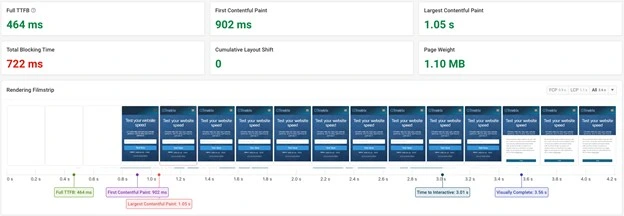
Currently, a loading speed of under 3 seconds is favored by search engines. Websites and blogs with a fast-loading speed get a boost in rankings.
Therefore, spend time auditing your blog and finding out what could be slowing down your speed - heavy image sizes, plugins, design elements, etc., could be contributing to your slow speed. Optimize these elements to see a slight boost in blog rankings.
3. Engaging Blog Titles
Writing engaging, captivating, and value-adding titles is a must for your blog. You could have the best-written article, but it's the blog's title that shows up in SERPs, so it has to grab your users' attention. Click-Through Rate (CTR) plays an important part in SEO, so finding the right title is an absolute must.
However, just having an enticing title isn't enough; it must also fulfill the search query and include your primary keyword.
For example - a title such as '10 best doctors in Kansas City ranked by patients' will perform better than a generic title because it uses the main keyword, and by adding 'ranked by patients,' it has an emotional marketing value that hooks users.

Advise your blog writers to give you multiple options for titles so that you can select the best one for your blog.
4. Use Captivating Images
Images motivate users to stay on the page and scroll down through your blog content. Therefore, creating feature blogs images and internal images that support your content helps keep the user hooked.
Image SEO processes such as keyword file names, site maps, image size, image format, etc., should also be optimized so that the images in your blog also contribute to the blog showing up in images searches and queries.
When selecting your photos, make sure that their content resonates with your target audience (keeping in mind gender, race, age, etc). Plus, ensure that the image file size doesn't slow down page loading speed, as images tend to take more time to load.
5. Structure Is Important
Besides the SEO advantages of implementing headers in your blog content, structuring it to be easy to read will also keep users on your page. Confusing, cluttered blog designs with text-heavy content can put off a user.
An easy-to-read blog will perform well with users and search engines because readability is a ranking factor.

Use white space appropriately, along with subheaders, headers, bullet points, infographics, images, etc., to streamline the blog and make the content shine.
Your main title should use an H1 header followed by H2, H3 - depending on the content, there should be a hierarchy to show the different sections.
6. Use Internal Links
Using internal links is an essential step when doing SEO for your blog. It gives users and search engine crawlers a clear idea of the contextual relationship between the two pages.
Linking to older posts that relate to the content will make users check out your other posts and boost traffic to those pages. Using internal links is an excellent practice to improve your on-page SEO, so make it a habit to try and include as many relevant links when writing your blog content.
Make the link open in another tab so that whether you're linking to external sites or your very own, users don't click off the page that brought them to your blog.
7. Limit Your Ad Spaces
Ad spaces impact your page loading speed significantly, slowing it down, which will lower the performance of all your SEO efforts.
Additionally, too many ad spaces can clutter a page, negatively influence your readability factor, and put off a user who doesn't want to be bombarded by extra adverts.
Keeping all these important factors in mind, it's a good idea to limit your blog's ad spaces, keeping it streamlined and visually pleasing. If you have to use ads on your blog, check the analytics on which ads give the best revenue and trim the ones that don't - only use the high performers.
8. Don't Forget Meta Descriptions
Another on-page SEO process is writing concise and engaging meta descriptions for your blogs. The short lines of text that appear under your title link are what users read before deciding to click on your link.
Plus, crawlers use meta descriptions to rank pages and better understand the page's content. So, it's an SEO process that you should start to implement in newer and old blog posts.
However, some SEO specialists argue that meta tags/descriptions aren't a huge ranking factor, it's still an excellent place to input keywords. Plus, it shows up when users share your link on their social media feeds. Therefore, writing meta descriptions, in our opinion, is still a good on-page SEO process.
9. Hire Expert Content Writers
Look at any blog that is performing well, and you'll find that the content they publish is well written, well researched, unique, adds value to users, is up-to-date, and relevant.
Content is the most critical part of a blog and making sure that you get the best quality blogs depends on the people writing them. Bottom line, it's better to invest in SEO for blogs that are well written than on those that aren't.
So, hire expert content writers who are knowledgeable about SEO practices but who can also assimilate information and deliver it to users in a way that fulfills their search query.
Publishing high-quality content will make your blog an authority in your niche, and therefore, positively impacts your blog ranking.
Ready To Rank?
It's best to implement these 9 SEO tips while creating your blog content, so you don't have to optimize it later, and it can start working for you as soon as you hit publish.
However, if you've got an existing blog, then making the changes to older posts will significantly affect your blog ranking and the traffic it garners.
These 9 tips are just the start of your blog SEO journey. Looking into technical, on-page and off-page SEO processes will further help your blog rank on SERPs.
However, the ones we listed above are a must for any good SEO plan. We hope you implement them and start reaping the ranking results. We're constantly updating our content, so keep checking back for the latest SEO tips and tricks!